NAB Show 2026 Attendee List: Exhibitors, Themes, and Who to Target
Quick answer: A NAB Show 2026 attendee list includes verified names, titles, companies, and emails of the 55,000+ media and entertainment professionals attending April 18-22 in Las Vegas. WhoGoes surfaces NAB attendees from public LinkedIn posts with proof of attendance. Preview 5 contacts free at /events/2026-nab-show.
What Is a NAB Show 2026 Attendee List?
A NAB Show 2026 attendee list is a database of verified media and entertainment professionals attending the NAB Show in Las Vegas, April 18-22. Biggest show in media tech. It's not close.
NAB Show 2026 runs at the Las Vegas Convention Center, 1,000+ exhibitors, 55,000+ attendees from 160 countries, and a programming lineup that spans broadcast infrastructure, streaming technology, AI workflows, sports production, and the creator economy. It is the largest media and entertainment technology trade show in the world — and its 2026 edition introduced two dedicated AI Innovation Pavilions for the first time, a structural change that signals where the industry's buying budget is actually moving.
If you sell into broadcasting, streaming, media production, advertising technology, or AI for content workflows, this is the event. Four days where your buyers, your competitors' customers, and the people evaluating their next technology investment are all under the same roof.
This guide covers what's actually being shown on the floor, which programming areas are drawing decision-makers with budget, and how to work the show without burning three days walking past booth demos that aren't relevant to your pipeline.
For the complete guide to building event attendee lists, see How to Get a Trade Show Attendee List in 2026. New to attendee lists? Start with What Is a Trade Show Attendee List?. Or browse all covered events at /events.
NAB Show 2026: By the Numbers
Scale matters. Biggest show in media. Here's the headline data for NAB Show 2026, sourced from official NAB figures, which gives you the foundation for understanding the scope of the list you're building and the density of the buying audience concentrated in Las Vegas for four days.
| Dates | April 18-22, 2026 |
| Location | Las Vegas Convention Center, Las Vegas, NV |
| Attendees | 55,000+ (61,100 registered in 2024) |
| Exhibitors | 1,000+ |
| Countries Represented | 160+ |
| International Attendance | 26% |
| First-Time Attendees | 53% (2025 figure) |
| New for 2026 | Two AI Innovation Pavilions (first time) |
Source: NAB Show official attendance figures
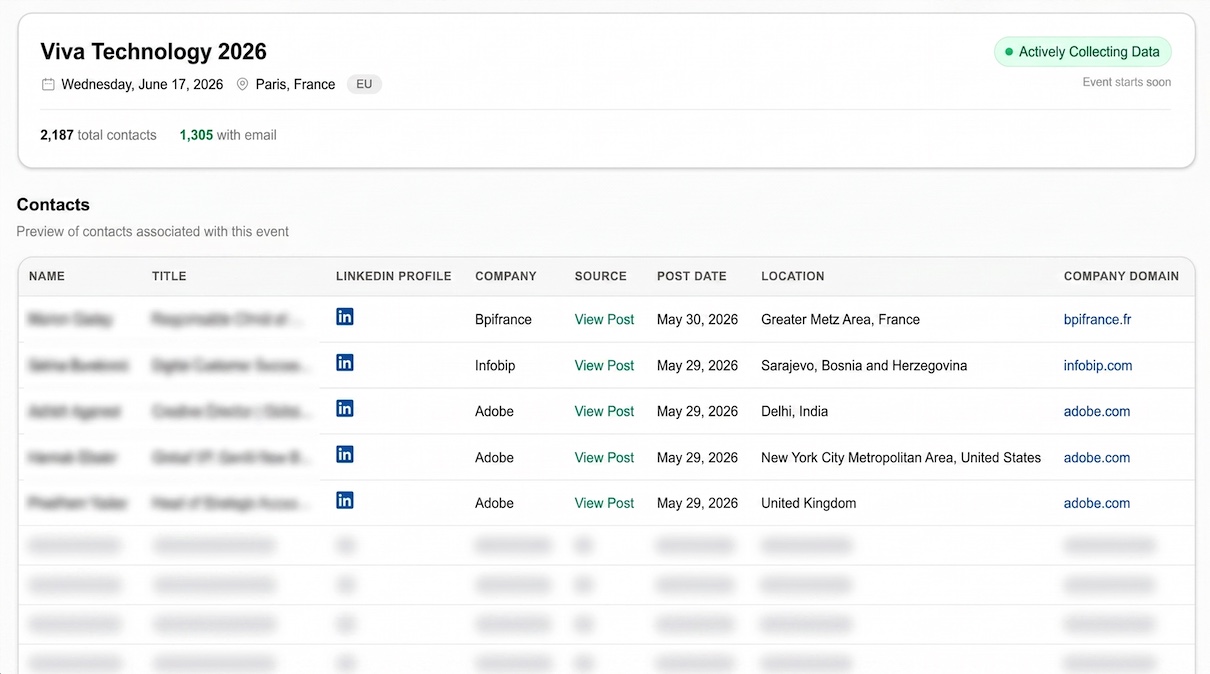
Want the NAB Show 2026 attendee list now? Preview 5 verified contacts free, each with LinkedIn proof of attendance.
Preview NAB Show 2026 freeWhat NAB Show 2026's Exhibitors Are Actually Showcasing
The exhibit floor at NAB Show 2026 breaks into several distinct technology clusters. Four main zones. Knowing which cluster matters for your pipeline saves you from wandering through 1,000+ booths hoping to bump into the right person.
AI Innovation Pavilions (Two in 2026, First Time Ever)
NAB doubled down on AI this year. Two dedicated AI Innovation Pavilions on the show floor make AI the center of the event, not a side track. This is the single biggest programming change at NAB 2026. That's not hype. Exhibitors in these pavilions cover:
-
AI-powered content creation, Generative video tools, AI-assisted editing, automated post-production workflows. Vendors here are targeting post-production houses and content studios that need to produce more output without scaling headcount proportionally.
-
Automated metadata tagging and content management, Media asset management platforms using AI for search, classification, and rights tracking. Broadcasters with decades of archived footage are the primary buyers.
-
AI-driven ad insertion and monetization, Server-side ad insertion, dynamic ad replacement, and AI-optimized ad placement for streaming platforms. The buyers here sit in ad operations and revenue teams, not engineering.
-
Content protection and authentication, Deepfake detection, content provenance, and digital watermarking. A growing category driven by regulatory pressure and brand safety concerns.
If your product touches AI for media workflows, these two pavilions are where your buyers are concentrated. The conversations happening around live demos are categorically more productive than scheduled meeting rooms.
Broadcast Infrastructure and IP Migration
The traditional heart of NAB. Major exhibitors include:
-
Sony, Camera systems, production switchers, and professional monitors. Sony's NAB presence draws cinematographers, broadcast engineers, and equipment procurement teams from networks worldwide.
-
Blackmagic Design, Camera, editing hardware (DaVinci Resolve), and ATEM switchers. Blackmagic's NAB booth is consistently one of the busiest on the floor. Their buyer base spans indie creators to large broadcast facilities.
-
AWS, Cloud-based media production and distribution infrastructure. AWS Elemental for encoding, MediaLive for live streaming, and cloud-native playout. The buyers visiting the AWS booth tend to be CTOs and VP Engineering at streaming platforms and broadcasters evaluating cloud migration.
-
Microsoft, Azure Media Services, AI tools for content workflows, and enterprise collaboration for media teams. Microsoft's NAB presence has grown significantly as broadcast and media companies adopt Azure for production workloads.
-
Google, Google Cloud for media, Google DeepMind demos, and YouTube infrastructure partnerships. Google's 2026 NAB presence includes executives from both Cloud and DeepMind, signaling that AI for media is a strategic priority.
Sports Media Technology
The Sports Summit is now a four-day program open to all attendees, previously limited to premium pass holders. That expansion signals NAB sees sports media as a high-growth segment. Exhibitor categories in the sports zone include:
-
Real-time replay and highlight systems, Vendors offering AI-powered instant replay, automated highlight generation, and multi-angle replay tools for live sports production.
-
Remote production platforms, Cloud-based remote production (REMI) tools that let broadcasters produce live events without full crews on-site. This is an active buying category as networks cut production costs.
-
Fan engagement technology, Interactive overlays, second-screen experiences, real-time stats integration, and personalized viewing. OTT platforms and sports rights holders are the primary buyers.
The Sports Summit draws a distinct crowd: live production directors, remote operations managers, and sports rights holders. Their buying cycles are tied to broadcast rights renewals and league season schedules, so timing your outreach to the Sport Summit window can catch prospects mid-budget-cycle.
Creator Lab (Expanded, New Central Hall Location)
The Creator Lab moved to the newly completed Central Hall with a bigger theater, dedicated classroom space, and a new Networking Lounge for creator-brand meetings. This area is where the YouTube, podcast, and independent film crowd congregates.
Exhibitors here skew toward creator tools: camera accessories, streaming software, audio equipment, editing tools, and monetization platforms. The buyer profile is different from the broadcast infrastructure floor, smaller budgets, faster decision cycles, and influence-driven purchasing (if a major creator endorses a tool at the Creator Lab, expect a sales spike).
Reading the Session Schedule: Which Tracks Signal Active Buying
NAB runs hundreds of sessions across multiple stages and theaters. Not all sessions carry equal buying intent. Here's where to focus.
Business of Media and Entertainment Summit (with The Ankler)
A three-day program on the exhibit floor covering investment, consolidation, rights deals, talent economics, and the business strategy of global media. The partnership with The Ankler, an influential media industry newsletter, gives it editorial credibility that draws senior executives.
This track attracts dealmakers. Not engineers. The attendees here are C-suite executives, business development leads, and strategy officers evaluating M&A opportunities, content partnerships, and market positioning. Outreach tone needs to match: less "here's our product demo" and more "I'd value your perspective on [industry trend]."
AI and Machine Learning Sessions
Sessions on AI for media span both pavilions and the broader conference programming. Topics include:
- Generative AI for video production (practical implementations, not concept demos)
- AI governance and responsible deployment in media
- Machine learning for content recommendation and audience analytics
- AI-assisted quality control for broadcast and streaming
Attendees at AI sessions are in one of two modes: exploring (early stage, 12+ months from purchase) or evaluating (mid-funnel, 3-9 months, comparing specific vendors). The evaluators tend to ask technical questions about integration, latency, and accuracy benchmarks during Q&A. The explorers ask conceptual questions about use cases and ROI frameworks.
ATSC 3.0 and NextGen TV Sessions
The transition to ATSC 3.0 (NextGen TV) remains a major infrastructure investment for U.S. broadcasters. Sessions cover deployment status, monetization strategies, and hybrid broadcast-broadband models. Attendees in this track are broadcast engineers and CTOs at local and national TV stations with active infrastructure budgets.
This is a high-intent track. Nobody attends a session on ATSC 3.0 transmitter deployment for fun. They're spending money.
The full session schedule is published at nabshow.com. Cross-reference which sessions your target accounts' team members are likely attending based on LinkedIn titles. VP Engineering at a streaming company will cluster in cloud and AI sessions. A broadcast chief engineer gravitates toward ATSC 3.0 and IP migration tracks.
Working the Las Vegas Convention Center: A Floor Strategy for NAB's Layout
The Las Vegas Convention Center spans multiple halls across the main campus and the new West Hall. NAB 2026 uses the full facility. Without a plan, you'll spend Day 1 in the West Hall and realize on Day 3 that the AI Pavilion you needed was in a completely different building — a three-minute walk that feels much longer when you're already behind on meetings and carrying a bag full of brochures nobody asked for.
Start with technology clusters, not hall numbers.
NAB organizes exhibitors by technology category, but categories span halls. The AI Innovation Pavilions are in dedicated zones, but AI-adjacent exhibitors are also scattered across the broader floor. Build your must-see list using the NAB Show floor plan and exhibitor directory before you arrive.
Morning sessions, afternoon floor.
Conference sessions start early. The exhibit floor opens at 10 AM. The 90-minute window between floor opening and the start of lunchtime meetings (roughly 10-11:30 AM) is your highest-quality booth time. Staff are energized. Crowds are manageable. Decision-makers who skipped morning sessions to walk the floor are accessible.
After 2 PM, the floor gets crowded and booth conversations get interrupted. Save afternoon time for scheduled meetings or for revisiting booths where you want a deeper technical conversation.
The Creator Lab is in Central Hall. Don't forget it exists.
The Creator Lab's move to Central Hall physically separates it from the main broadcast infrastructure floor. If your ICP includes content creators, YouTube-native producers, or podcast professionals, you need to specifically block time for Central Hall. It's easy to spend three days on the main floor and never visit the Creator Lab. That's a mistake if creator-focused buyers are part of your pipeline.
Use the Sports Summit as a filtering mechanism.
The Sports Summit's four-day programming runs parallel to the main exhibit floor. Attendees who show up consistently for Sports Summit sessions are self-selecting as sports media technology buyers. If you sell into live production, remote operations, or fan engagement, the Sports Summit lobby and session breaks are higher-density networking windows than the general exhibit floor.
The Investment Signals Embedded in NAB 2026's Programming Choices
NAB's programming decisions tell you where the industry is spending money. The 2026 lineup sends several clear signals.
AI moved from sideshow to centerpiece. Two dedicated AI Pavilions, not one, two, says NAB's leadership believes AI for media has crossed the adoption threshold from "interesting experiment" to "critical infrastructure." For vendors selling AI tools, this means your competitive landscape just got more crowded, but buyer readiness also jumped.
Sports media is a standalone category now. Opening the Sports Summit to all attendees (previously premium-only) means NAB expects sports technology to drive attendance and exhibitor revenue. Real growth. The sports media technology market is growing faster than the broader broadcast market, driven by streaming rights economics and the arms race for fan engagement.
The creator economy earned its own building. Moving the Creator Lab to Central Hall with expanded programming reflects a permanent shift: creators are no longer a novelty segment at NAB. They represent a distinct buying audience with different technology needs, different price sensitivities, and different purchase cycles than broadcast engineers or streaming platform CTOs.
International attendance is structurally high. NAB reports 26% international attendance from 160+ countries. International buyers often attend NAB as their primary North American technology scouting trip. If you sell into European or Asian media markets, the NAB floor is where these buyers come to you.
One more signal. According to NAB, 53% of 2025 attendees were first-timers. More than half the room is new to the event every year. Your outreach is hitting fresh contacts who haven't been approached by every vendor under the sun. That's unusual for a conference this size.
Turning NAB 2026 Floor Intelligence into Post-Show Pipeline
NAB runs April 18-22. The outreach window is open right now. Calendars are filling fast.
Right now (late March, 3-4 weeks out). Build your attendee list immediately. LinkedIn posts about NAB travel plans, booth previews, and session priorities are peaking. People have committed to attending but haven't locked their schedules. This is the sweet spot.
First week of April (2-3 weeks out). Send your first outreach wave. Reference NAB Show 2026, mention the specific pavilion or summit relevant to them, propose a concrete meeting time and location. "Would Tuesday at 2pm at the West Hall lounge work?" outperforms "let's connect at NAB."
Week of April 13 (1 week out). Follow up with non-responders. Add new contacts who just posted about attending. The NAB mobile app launches around this time, so attendees are actively building schedules.
During the show (April 18-22). Day-of messages that reference specific floor locations work. "I'm at the AI Pavilion in West Hall right now, want to swing by?" beats "great to be at NAB."
Post-event (April 23+). Follow up with everyone on your list you didn't reach. The shared context of "we were both at NAB" keeps the conversation warm for two weeks after the event closes.
Three weeks to the show is tight. But workable. Focused outreach with a verified attendee list and personalized messages can book 8-10 solid meetings in two weeks — especially when you reference the specific pavilion or summit your prospect is most likely to spend time in, which signals you've actually done the homework instead of mass-emailing everyone who has "media" in their LinkedIn title.
Getting Your NAB Show 2026 Attendee List
NAB doesn't sell attendee lists. If you exhibit, you get badge scan data for people who visited your booth. That's it. You don't get the other 54,999 attendees. Badge scans are not a pipeline.
WhoGoes surfaces verified NAB Show 2026 attendees from public LinkedIn posts. Every contact includes a name, job title, company, verified email (when available), and the LinkedIn post where they mentioned attending NAB. When your outreach references the prospect's actual LinkedIn post about heading to NAB, they know you didn't just buy a scraped list, and that distinction matters in a 55,000-person crowd where every vendor is sending the same five-step email sequence to the same recycled contact database.
Preview 5 NAB Show 2026 contacts free on the NAB Show 2026 event page before spending anything. Credits start at $29 for 200 contacts. No subscription. No contract. Credits never expire. If you're also targeting GDC 2026 or other media and tech conferences, the same credits work across all 1,200+ events.
For the complete guide to all methods of building event attendee lists, see How to Get a Trade Show Attendee List in 2026.
Related Reading
Start here. All free. These resources give you the full context around NAB Show outreach, from building your initial list to verifying who actually showed up and following up with the right message for each buyer type.
- How to Get a Trade Show Attendee List in 2026, complete methodology for sourcing verified attendee data
- Trade Show Attendee Data for SDRs, how B2B sales teams use attendee lists for pipeline
- Trade Show Calendar 2026-2027, top B2B events by industry for planning your year
Ready to get your attendee list?
Browse 1,200+ trade shows. 5 free preview contacts per event.
Browse Events Free