HIMSS 2026 Attendee List: Who's Going and How to Reach Them
Quick answer: A HIMSS 2026 attendee list includes verified names, titles, and emails of the ~30,000 healthcare IT professionals who attended in Las Vegas. WhoGoes surfaces HIMSS attendees from public LinkedIn posts with proof of attendance. Preview 5 contacts free at /events/himss-2026.
What Is a HIMSS 2026 Attendee List?
A HIMSS 2026 attendee list (sometimes searched as a HIMSS 2026 attendees list) is a database of verified healthcare IT professionals who attended HIMSS 2026, including names, job titles, companies, and contact information. Whether you call it a HIMSS 2026 attendee list or a HIMSS 2026 attendees list, the goal is the same: a clean, deduped, sales-ready roster of people you can actually reach.
HIMSS, the Global Health Conference & Exhibition, is not a typical technology trade show. Most events aggregate buyers from a broad industry. HIMSS goes deeper: it draws one specific buyer type from hundreds of sub-segments, then stacks them 30,000 high across a five-day program spanning clinical informatics, IT infrastructure, government policy, cybersecurity, and revenue cycle transformation.
That specificity is the opportunity. For B2B sellers in health tech, HIT platforms, cybersecurity for healthcare, revenue cycle solutions, or population health, HIMSS is the single most concentrated moment your buyers share the same space all year. But only if you know who's actually in the room. That's the catch. Know your list.
HIMSS 2026 ran March 9-13 at the Venetian Expo & Convention Center in Las Vegas. The post-event outreach window is open right now. Here's what you need to know about who attended and how to reach them.
For the complete guide to building event attendee lists, see How to Get a Trade Show Attendee List in 2026. New to attendee lists? Start with What Is a Trade Show Attendee List?.
HIMSS 2026 by the Numbers
| Metric | Figure |
|---|---|
| Attendees | ~30,000 |
| Countries represented | 80+ |
| Exhibitors | 1,000+ |
| Decision-makers or influencers | ~75% |
| C-suite | ~33% |
| Dates | March 9-13, 2026 |
| Venue | Venetian Expo, Las Vegas |
What Health IT Buyers Are Actually Evaluating at HIMSS 2026
HIMSS isn't one homogeneous crowd with one homogeneous problem. Not even close. The themes driving attendance in 2026 are worth mapping to your product, because referencing the right theme in your outreach makes the difference between a reply and a delete.
AI in clinical workflows. This dominated the 2026 program. Not AI in the abstract, but specific clinical use cases: ambient documentation (AI scribes replacing dictation), clinical decision support, predictive risk stratification, and AI-assisted imaging. If your product touches any of these, you had a floor full of buyers in active evaluation mode.
Interoperability and FHIR mandates. The CMS Interoperability and Prior Authorization Rule went into effect for many payers in 2026, and the HL7 FHIR API requirements created urgency for health systems and payers alike. Buyers attending interoperability sessions were actively shopping, not just researching. This is one of the clearest buying signals at HIMSS: someone who showed up specifically to learn about FHIR implementation is a hot prospect for integration platforms, API middleware, and data exchange tools.
Cybersecurity in healthcare. This one shifted fast. Following high-profile ransomware attacks on major health systems, cybersecurity moved from a cost center to a board-level priority. HIMSS 2026 had dedicated cybersecurity programming that drew CISOs, IT directors, and risk officers who rarely attend general health IT conferences.
Revenue cycle transformation. Money talks. Automation of prior authorization, denial management, and coding workflows is the top operational priority for health system CFOs right now. Revenue cycle buyers at HIMSS tend to be mid-funnel, they're not just learning, they're actively comparing vendors.
Value-based care infrastructure. Population health platforms, care management tools, and analytics for risk contract performance drew a distinct segment of clinical and administrative leaders who operate in ACOs and health plans.
Knowing which sessions your prospect attended, or which pavilion they gravitated toward, tells you more about their buying intent than their job title alone.
Inside the HIMSS Attendee Mix: Roles, Segments, and Who Holds the Budget
Nearly 75% of HIMSS attendees are decision-makers or influencers. About one-third are C-suite. That's an unusual concentration for a 30,000-person event. Rare density. For sellers, that concentration is the entire reason HIMSS earns a line in the travel budget, because nowhere else do this many health system decision-makers and their internal champions gather under one roof at the same time.
Here's how the attendee mix breaks down in practice:
| Role Segment | Key Titles | What They're Buying |
|---|---|---|
| Health System IT Leadership | CIO, CISO, VP of IT, Director of IT Infrastructure | EHR integrations, cybersecurity platforms, cloud infrastructure, IT services |
| Clinical Informatics | CMIO, CNIO, Clinical Informatics Director, CMO | AI clinical tools, clinical decision support, ambient documentation, workflow software |
| Revenue Cycle | VP of Revenue Cycle, Director of HIM, VP of Coding, CFO | RCM automation, denial management, prior auth tools, coding AI |
| Executive Leadership | CEO (health system), COO, CFO, Chief Strategy Officer | Strategic partnerships, enterprise software, analytics platforms |
| Digital Health Vendors | Startup CEO/CTO, VP of Sales, VP of BD | Partnership deals, integration announcements, investor meetings |
| Payers / Health Plans | VP of Technology (payer), Director of Digital Health | Interoperability compliance tools, member engagement platforms |
| Government & Policy | ONC leadership, CMS officials, state health IT directors | Standards setting, policy input, vendor capability assessment |
| Ambulatory & Specialty Care | Medical Director (ambulatory), ASC Administrator | EHR optimization, patient engagement, telehealth tools |
A few things stand out in this breakdown. First, the vendor segment is large, roughly 20-25% of HIMSS attendees work for health IT companies exhibiting or partnering at the event. This means your list is noisier than most people expect. Filtering by hospital/health system vs. vendor is the single most important list hygiene step for HIMSS outreach.
Second, the government segment (ONC, CMS, state HIE officials) is small but high-influence. These aren't buying your product, but they're shaping the mandates that create your market. Worth knowing who they are.
Third, the payer segment is undersized for its buying power. Health plans and insurance companies send fewer representatives than health systems, but they're often mid-funnel buyers with allocated technology budgets and specific interoperability mandates to comply with.
The HIMSS Attendee Profile Most SDRs Walk Right Past
Everyone targets the CIO. It's the obvious move. The HIMSS badge scanner sees ten SDRs from competing vendors approach every health system CIO within 30 minutes of the exhibit floor opening.
The profiles that actually convert at HIMSS, the ones most reps ignore, are further down the org chart but much closer to the actual buying decision:
Clinical Informatics Directors. These are the people who own EHR configuration, clinical workflow design, and physician adoption programs. They're not the final budget approver, but they're the internal champion or blocker for virtually every clinical technology purchase. A CIO who likes your product will still kill the deal if the Clinical Informatics Director says no. Finding and engaging them first is a smart early move.
Revenue Cycle Operations Managers. VPs of Revenue Cycle get the attention. But the Revenue Cycle Operations Manager, who actually runs the denial workflow, manages the coding team, and owns the metrics that revenue cycle software is supposed to improve, is often the one who wrote the requirements document. They're more accessible on the show floor, more willing to give you 20 minutes, and more likely to become your internal champion.
Ambulatory Care and Specialty Clinic Leaders. Most HIT sales teams focus on large health system IT departments. But ambulatory networks, the dozens of outpatient clinics affiliated with a major health system, often have separate technology evaluation processes and smaller vendor fields. Medical Directors of ambulatory networks at HIMSS are shopping for the same category of solutions as hospital CIOs but with less competition for their attention.
Pharmacy Informatics Directors. As medication safety and pharmacy automation became a bigger part of digital health strategy, pharmacy informatics leaders started showing up at HIMSS in meaningful numbers. They're often invisible to reps who aren't selling pharmacy-specific solutions, but for clinical workflow, medication reconciliation, or patient safety platforms, they're highly relevant buyers.
Population Health Program Managers. Large health systems running ACOs and risk contracts have dedicated population health teams that evaluate analytics, care management, and patient engagement platforms. The VP of Population Health is hard to get to. The Population Health Program Manager who runs day-to-day vendor evaluation is not.
When building your HIMSS attendee list, segment by title seniority AND by function. Don't just filter for "Director and above." Filter for specific functional titles (Revenue Cycle, Clinical Informatics, Population Health) and you'll find the buyers your competitors overlooked.
Want the HIMSS 2026 attendee list now? Preview 5 verified contacts free, each with LinkedIn proof of attendance.
Preview HIMSS 2026 free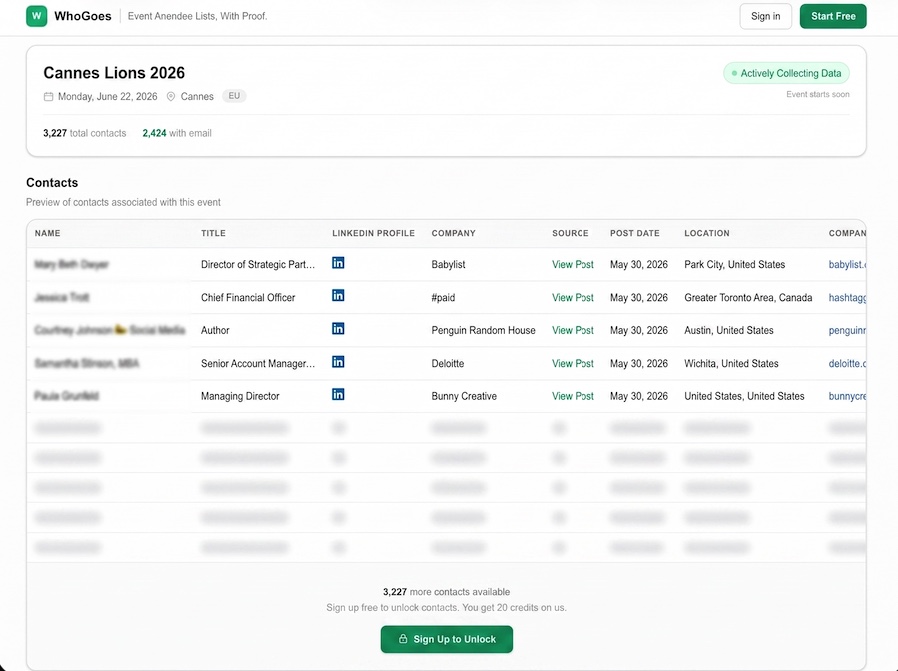
Buyer Signals at HIMSS: What a Hot Lead Actually Looks Like on the Show Floor
HIMSS generates buyer signals that are highly specific to healthcare IT, and they're different from signals at a general B2B tech conference. Knowing what to look for (and what to reference in your outreach) is the difference between "touching base" emails and emails that get replies.
EHR migration mentions. This is the big one. Any organization in the middle of, or planning, an Epic, Oracle Health (Cerner), or Meditech implementation is in active buying mode across every category that integrates with their EHR. If a prospect mentions "we're mid-migration" or "we just went live on Epic," they have active budget and active pain.
CMS mandate urgency. Contacts who attended the interoperability or prior authorization sessions at HIMSS and mentioned specific CMS rules (CMS-0057-F, the Interoperability and Prior Authorization Rule) are not casual learners. They're responding to regulatory pressure with timeline. The urgency is real.
Questions about FHIR APIs and integration. "We're trying to get our systems talking to each other" is the HIMSS equivalent of "we're shopping for a solution." Any prospect who asked vendor questions about HL7 FHIR R4 integration, bulk FHIR APIs, or SMART on FHIR is mid-funnel regardless of their title.
AI governance and clinical validation questions. Health systems that are asking about AI explainability, FDA clearance for clinical AI, or governance frameworks for model deployment are further along in AI evaluation than peers still asking "what is generative AI." These are buyers who've done internal research and are stress-testing vendor claims.
Post-show LinkedIn posts about specific sessions. When a HIMSS attendee posts on LinkedIn summarizing a session they attended, especially sessions on specific clinical use cases or vendor categories, they're telling you exactly what they're evaluating. "Fascinating panel on ambient AI documentation" from a CMIO is a more valuable signal than any intent data score.
Booth visit behavior. If you exhibited at HIMSS, the categories of booths a badge-scanned contact visited (cybersecurity pavilion, interoperability hub, AI Innovation Zone) tell you which budget line they came with.
Reference the session or theme in your post-HIMSS outreach, not just the event. "I noticed you were at the ambient documentation panel" beats "great seeing everyone at HIMSS." Healthcare buyers at this seniority level can tell when your opening is generic.
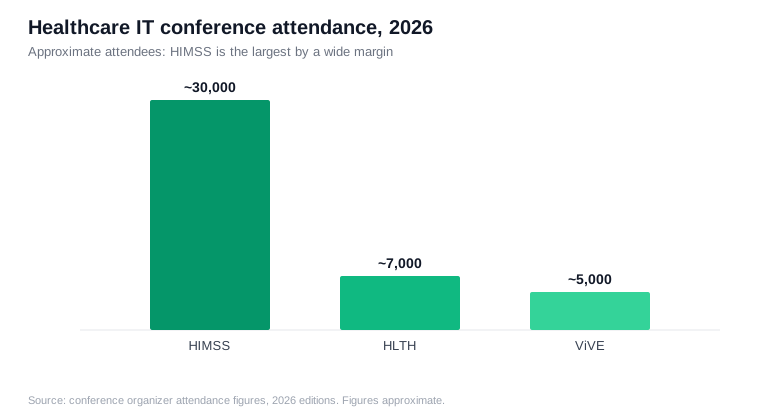
HIMSS vs. HLTH vs. ViVE: Three Distinct Healthcare Tech Crowds
If you're allocating your health tech event budget across multiple conferences, understanding the actual audience differences matters. They're not interchangeable. Three shows. Three crowds.
| HIMSS 2026 | HLTH 2026 | ViVE 2026 | |
|---|---|---|---|
| Attendance | ~30,000 | 12,250+ (2025) | ~7,000-9,000 |
| Timing | March | October | February/March |
| Location | Las Vegas | Las Vegas | Nashville |
| Primary Crowd | Health system IT + clinical informatics | Digital health startups + investors + innovators | Hospital executives + AHA-aligned leadership |
| Buyer Seniority | Mixed (CIO to manager) | C-suite heavy (but often vendor-side) | C-suite health system executives |
| Exhibitor Density | Very high (1,000+ exhibitors) | Moderate | Moderate |
| Investor Presence | Low | High | Low |
| Government Presence | High (ONC, CMS, state HIEs) | Low | Low |
| Best For Selling | Infrastructure, EHR integrations, RCM, cybersecurity, population health tools | Digital health innovation, consumer health, value-based care platforms | Enterprise health system software requiring executive buy-in |
HIMSS is the operational conference. The people who show up at HIMSS are running the systems, managing the budgets, and signing the contracts for clinical and administrative health IT. It's not glamorous in the way that HLTH can be, but it's where deals happen.
HLTH is the innovation showcase. Attendance skews toward digital health founders, venture-backed startups, and investors. The health system executives who attend HLTH tend to be innovation officers and strategy leaders, not the IT and operations buyers who run procurements. If you're trying to get a strategic partnership meeting or a pilot agreement with a forward-looking system, HLTH is useful. If you're trying to sell software, HIMSS is the room.
ViVE is the executive relationship conference. With AHA alignment and a more curated, smaller attendance, ViVE pulls hospital CEOs, COOs, and system-level executives who often don't attend HIMSS at all. It's a higher-touch networking event than an exhibit floor play. Badge scanning doesn't apply the same way. For enterprise deals that require board-level relationship building, ViVE earns its spot on the calendar.
Worth noting: a number of buyers attend all three, treating HIMSS as their operational learning event, ViVE as their peer relationship event, and HLTH as their "what's coming in three years" scan. If someone is on your HIMSS list and you see them mentioned at HLTH in October, that's a warm signal, they're invested in staying current on the category.
Post-Event Outreach: Reaching HIMSS 2026 Attendees While the Window Is Open
HIMSS 2026 wrapped March 13. As of today, you have roughly a two-week window where "I saw you at HIMSS" still lands with full relevance and your outreach doesn't feel stale.
Healthcare buyers are a specific audience for post-event follow-up. Speed matters here. The executives you're emailing process dozens of vendor messages in the first week after HIMSS, so the note that gets a reply is the one that references a specific session, mandate, or hallway conversation rather than the event in general. A few things that work:
Reference a specific HIMSS moment, not just the event. "I saw your LinkedIn post about the AI governance session" is personalized in a way that "great conference this year" is not. Healthcare executives process a lot of vendor outreach. Generic references to HIMSS tell them you bought a list. Specific references tell them you paid attention.
Connect your product to a 2026 regulatory reality. The HIMSS attendees who came specifically to understand CMS interoperability mandates, ONC certification requirements, or the 21st Century Cures Act information blocking rules have a compliance deadline driving them. That deadline is your urgency. Frame your solution in the context of that mandate.
Don't ask for 30 minutes. Just don't. Healthcare leaders, especially CIOs and CMIOs, have clinical operations to support and IT teams running at capacity. Ask for 15 minutes, be specific about the problem you solve, and propose two concrete time slots. "Would Tuesday at 10am or Thursday at 2pm work?" outperforms "let me know when you're free."
Use the right channel. LinkedIn works well for HIMSS follow-up because attendees are still active on the platform post-conference. Email works for director-and-above contacts with verified addresses. Calling through a main hospital line rarely reaches IT leadership.
Browse all HIMSS 2026 contacts and related healthcare IT events at /events.
The two-week post-HIMSS window closes fast. After March 27, response rates on HIMSS-specific outreach drop significantly as the event fades from top of mind. If you're building your list now, prioritize sending your first wave this week.
Getting Your HIMSS 2026 Attendee List
You don't need to spend $10,000+ on an organizer list or burn hours scrolling LinkedIn manually. There's a faster way.
WhoGoes surfaces verified HIMSS 2026 attendees from public LinkedIn posts. You get names, job titles, companies, emails, and the actual LinkedIn post as proof of attendance. That proof matters: when your outreach references something the person publicly said about attending HIMSS, your reply rate climbs because you're not guessing who was there.
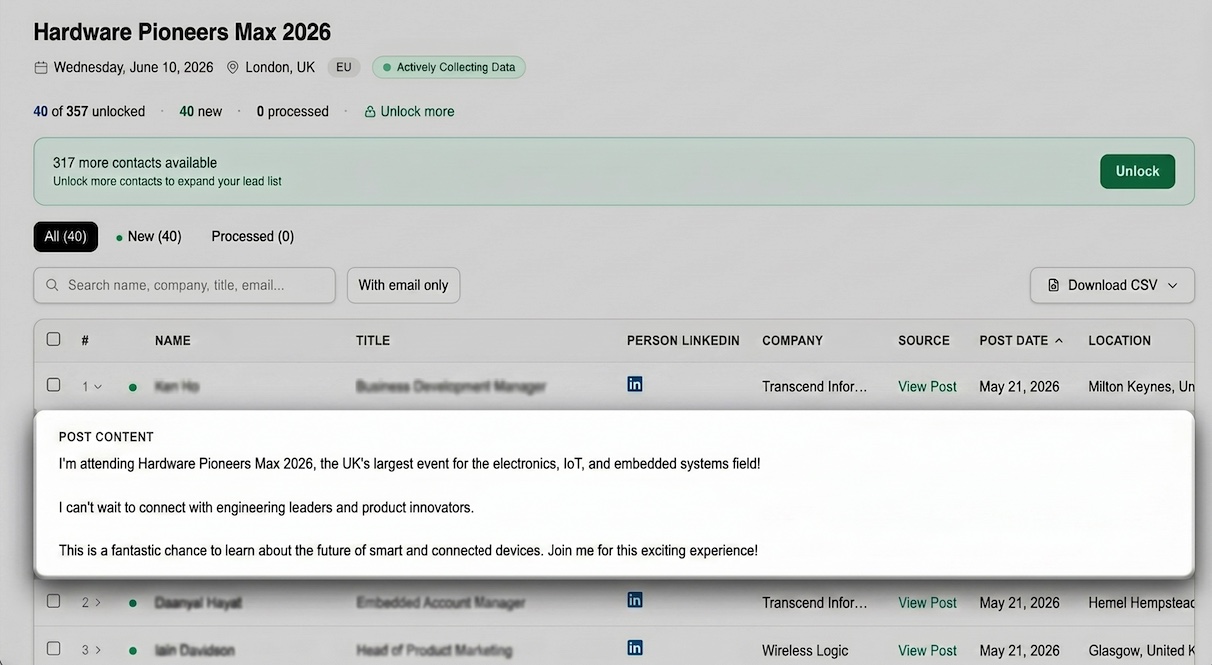
Preview 5 HIMSS 2026 contacts free on the HIMSS 2026 event page before spending anything. If you need more, credits start at $29 for 200 contacts. No subscription, no contract, credits never expire. Unlike purchased lists or generic healthcare databases, every contact comes with LinkedIn proof they were actually at HIMSS, not just a name from a hospital directory.
One balance. Every event. Across 1,200+ events, it's the fastest way to go from "who attended HIMSS?" to a CRM-ready outreach list with evidence of attendance, and if you're also prospecting for HLTH 2026 or ViVE 2027, the same credits carry over so you never have to rebuild your tooling for the next show on the calendar.
For the complete guide to all methods of building event attendee lists, see How to Get a Trade Show Attendee List in 2026.
Related Reading
Keep going. Four picks. These guides go deeper on sourcing verified attendee data, using it inside an SDR outreach motion, planning your event calendar, and the overlapping digital health show that shares much of the HIMSS audience.
- How to Get a Trade Show Attendee List in 2026, complete methodology for sourcing verified attendee data
- Trade Show Attendee Data for SDRs, how B2B sales teams use attendee lists for pipeline
- Trade Show Calendar 2026-2027, top B2B events by industry for planning your year
- VIVE 2026 Attendee List - the other major US digital health show that overlaps significantly with HIMSS audience
Ready to get your attendee list?
Browse 1,200+ trade shows. 5 free preview contacts per event.
Browse Events Free