GEOINT Symposium 2026 Attendee List: Who's Going and How to Reach Them
Quick answer: A GEOINT Symposium 2026 attendee list includes verified names, titles, and emails of the 4,000+ geospatial intelligence professionals attending May 3-6 in Aurora, Colorado. WhoGoes surfaces GEOINT attendees from public LinkedIn posts with proof of attendance. Preview 5 contacts free at /events/geoint-symposium-2026.
What Is a GEOINT Symposium 2026 Attendee List?
A GEOINT Symposium 2026 attendee list is a database of verified professionals attending the USGIF GEOINT Symposium in Aurora, Colorado from May 3-6, 2026.
GEOINT is not a typical defense trade show. It pulls one very specific buyer type, geospatial intelligence professionals, from across the entire national security apparatus, then concentrates them 4,000+ strong across a four-day program spanning AI for imagery analysis, real-time intelligence pipelines, and operational-scale AI deployment. NGA analysts sit three rows behind Palantir engineers. Space Force officers share hallways with satellite imagery startup founders.
That concentration is the opportunity. For B2B sellers in geospatial technology, defense analytics, satellite imagery, AI/ML for classified environments, or ISR platforms, GEOINT is the single most targeted moment your buyers share the same space all year. But only if you know who's actually there.
GEOINT 2026 takes place at the Gaylord Rockies Resort & Convention Center. The theme is "Building a Secure Future." Narrow crowd. High stakes. Here's what you need to know about who's attending and how to reach them.
For the complete guide to building event attendee lists, see How to Get a Trade Show Attendee List in 2026. New to attendee lists? Start with What Is a Trade Show Attendee List?.
GEOINT Symposium 2026: By the Numbers
Numbers first. The baseline scale of the Symposium, from USGIF figures, so you can size your target list before you build it.
| Dates | May 3-6, 2026 |
| Location | Gaylord Rockies Resort & Convention Center, Aurora, CO |
| Attendees | 4,045 |
| Exhibitors | 216 |
| Theme | Building a Secure Future |
| Government Registration | Free |
| Organizer | USGIF |
| Pre-Conference Day | GEOINT Foreword, May 3 |
Source: USGIF GEOINT Symposium 2026
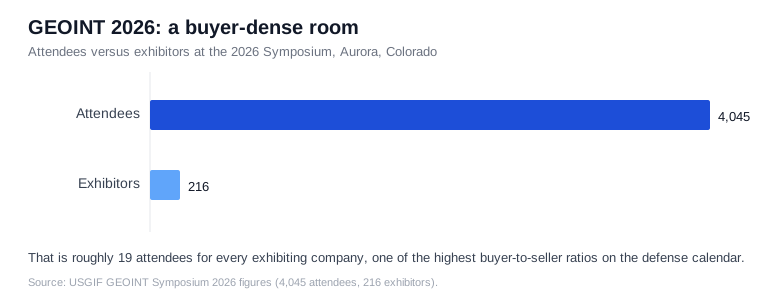
That ratio is the whole pitch. Buyers everywhere. Sellers, not so much. Your job is to find the right names in that room before the show floor opens.
What Geospatial Intelligence Buyers Are Actually Evaluating at GEOINT 2026
The three programming tracks at GEOINT 2026 aren't filler. Follow the money. They're a map of what the community is spending on right now, and each track draws a distinct buyer profile with distinct budget authority.
GeoAI (Sponsored by Leidos). This track dominates the 2026 program. Sessions cover AI/ML for imagery analysis, full-motion video exploitation, human-AI teaming in intelligence workflows, and responsible AI deployment in classified environments. The buyers here aren't asking "should we use AI?", they passed that milestone two years ago. They're evaluating specific vendors for specific mission applications: automated target recognition, change detection algorithms, and AI explainability frameworks that satisfy IC oversight requirements.
If your product touches computer vision for geospatial data, you have a floor full of mid-funnel buyers.
GEOINT Data at Speed (Sponsored by Capella Space). Real-time data acquisition, cloud-native analytics pipelines, and reducing the gap between satellite collection and analyst consumption. This track attracts the infrastructure buyers: the engineers and architects building intelligence pipelines that process terabytes of imagery per day and need to cut latency from hours to minutes.
Outreach angle here is technical. Talk throughput, latency, and integration with existing IC data environments. These buyers evaluate with benchmarks, not slide decks.
Scaling AI (Sponsored by NVIDIA). Moving AI from prototype to operational deployment. Federated learning, governance for production AI systems, interoperability across agencies, and the challenge of running AI workloads on both classified and unclassified networks. This track pulls the program managers and systems architects who've built proof-of-concepts and now need to operationalize them at mission scale.
The buying signal is clear: anyone attending Scaling AI sessions has budget allocated and is past the experimentation phase. They need a vendor who can deliver in a classified environment, not a demo that works on a laptop.
Reference the specific track name in your outreach. "I saw you're attending GEOINT 2026" is generic. "If you're sitting in on the GeoAI track, I'd like to show you how we handle automated target recognition for multi-INT fusion" starts a conversation.
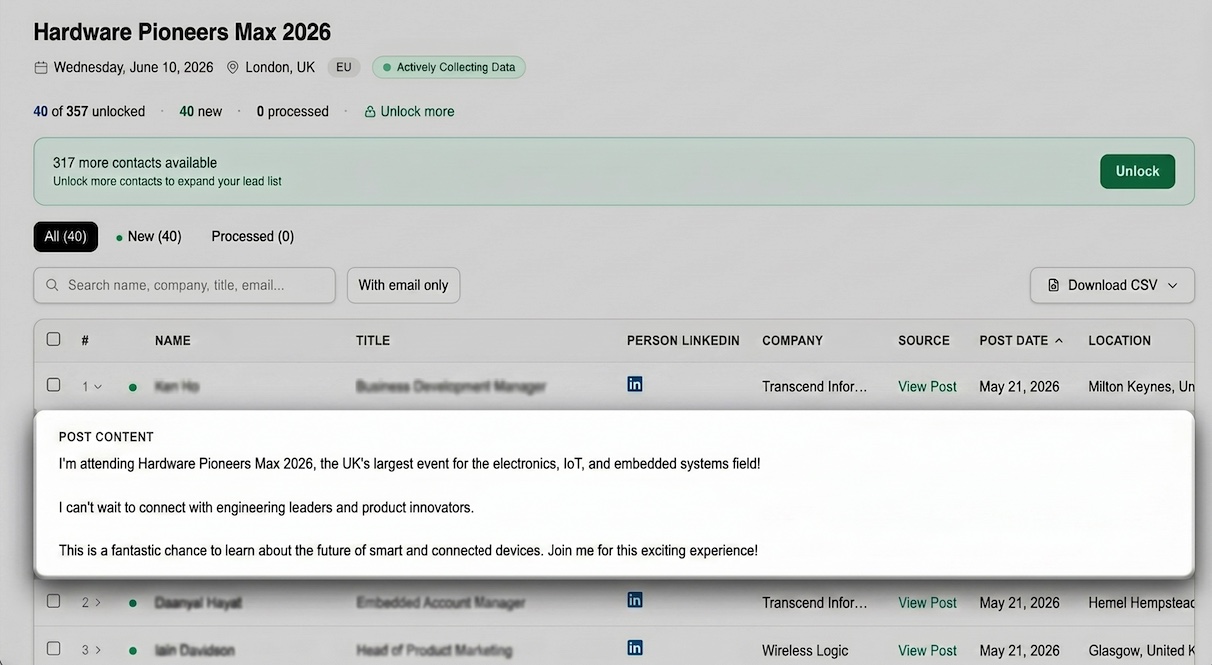
Want the GEOINT Symposium 2026 attendee list now? Preview 5 verified contacts free, each with LinkedIn proof of attendance.
Preview GEOINT Symposium 2026 freeInside the GEOINT Attendee Mix: Roles, Segments, and Who Holds the Budget
The GEOINT Symposium draws a narrower crowd than most defense conferences, and that's what makes it valuable. Almost everyone in the room is connected to the geospatial intelligence mission in some way. No casual attendees browsing exhibit halls because they got a free pass.
Here's how the attendee mix actually breaks down:
| Role Segment | Key Titles | What They're Buying |
|---|---|---|
| Intelligence Community (NGA, CIA, DIA) | Analysts, collection managers, program managers, division chiefs | Imagery analysis tools, AI/ML platforms, data management systems, cloud infrastructure |
| Military / DoD | Geospatial officers, CENTCOM/INDOPACOM planners, Space Force operators, ISR officers | Multi-domain operations tools, ISR tech, targeting systems, geospatial production |
| Defense Contractors (Primes) | Capture managers, BD leads, program managers at Leidos, Peraton, BAE, L3Harris, Maxar | Partnership opportunities, subcontract leads, competitive intelligence |
| Geospatial Tech Vendors | Product managers, sales engineers, CTOs at satellite and analytics firms | Customer acquisition, product demos, integration partnerships |
| Academic & Research | University researchers, national lab scientists, GEOINT Foreword participants | Research collaboration, student recruitment, technology transfer |
| Allied Nation Partners | Intelligence officers from Five Eyes and NATO allies | Interoperability solutions, joint mission planning, technology scouting |
A critical detail most people miss: U.S. Government employees attend GEOINT for free. That single fact skews the entire attendee composition. Government-to-industry ratio at GEOINT is dramatically higher than at commercial tech conferences. If your ICP includes federal buyers at NGA, the combatant commands, or the broader intelligence community, this concentration is unmatched anywhere else on the calendar, because nowhere else do that many government program managers show up in one building on a free badge.
One more thing. About 75% of buying decisions in the IC start with the program manager or technical lead, not the executive. The GS-14 or GS-15 program manager who runs a specific portfolio at NGA has more practical purchasing influence than many SES-level executives on the show floor. Target accordingly.
The GEOINT Attendee Profiles Most SDRs Walk Right Past
Everyone targets the NGA leadership table. Makes sense, they're the obvious whale accounts. But 30 other vendors had the same idea before breakfast on Day 1, which is exactly why that table is the most crowded and least productive square of carpet at the entire Symposium.
The profiles that actually convert at GEOINT are less obvious:
Mid-tier defense contractor capture managers. Leidos and Peraton get all the attention. But the 50+ mid-tier contractors at GEOINT (firms doing $200M-$2B in revenue) are often in active capture phases for GEOINT-related contracts. Their capture managers attend specifically to find technology partners and subcontractors who can strengthen a bid. They're not browsing. They have a specific procurement in mind and they're interviewing potential teammates. If you're a geospatial tech company that can be a subcontract partner on a defense prime bid, these are your highest-conversion contacts at GEOINT.
Military officers transitioning to industry. This is a GEOINT-specific phenomenon. Military geospatial officers who are within 12-18 months of transitioning to the private sector attend the Symposium to network with industry. They know the mission requirements intimately, they know the contracting landscape, and they'll soon be on the buying side at a defense contractor or consulting firm. Building a relationship now pays off when they land at a company that needs your product.
Combatant command planners. CENTCOM, INDOPACOM, AFRICOM, and EUCOM all send geospatial planners to GEOINT. These aren't the high-visibility NGA program managers, but they're the people who define operational requirements that become acquisition programs. A CENTCOM planner who mentions a specific geographic intelligence gap is telling you exactly what capability the command will fund next year.
GEOINT Foreword participants. The pre-conference day (May 3) targets young professionals and students through a dedicated program. These attendees are early-career, often already working at IC agencies or defense contractors in junior analyst or engineer roles. Not useful for immediate sales. Extremely useful for relationship building: these are the program managers and technical leads of 2030. If your sales cycle is 2-3 years, these contacts are pure gold.
Small geospatial startup founders. Dozens of geospatial AI startups exhibit at GEOINT with 10-person booths. Their founders attend every session. They're not your customers, they're your potential partners, acquisition targets, or competitive intelligence. Knowing which startups are gaining traction in the GEOINT community helps you understand where the market is moving.
Segment your GEOINT list by organization type first, then by title. A "Program Manager" at NGA, at Leidos, and at a 50-person geospatial startup are three completely different buyer personas with different budgets, timelines, and decision processes.
Buying Signals at GEOINT: What a Hot Lead Actually Looks Like
GEOINT generates buyer signals that are specific to the defense and intelligence community. They're different from signals at a commercial SaaS conference. Knowing what to reference in your outreach separates real pipeline from wasted emails.
NGA modernization program mentions. NGA is in the middle of a multi-year digital modernization effort. Any attendee who mentions GEOINT Services, Maven, Tearline, or NGA's data strategy by name is connected to active programs with allocated budget. That's not casual interest. That's a procurement signal.
Cloud migration discussions. The IC is moving workloads to commercial cloud environments (C2S, GovCloud, and the new multi-cloud initiatives). Contacts who ask about AWS GovCloud, Azure Government, or Google Distributed Cloud at GEOINT are telling you they're in the middle of an infrastructure transition that creates buying opportunities for every layer of the stack.
Session attendance patterns. GeoAI attendees are evaluating AI tools. Data at Speed attendees are evaluating infrastructure. Scaling AI attendees are operationalizing existing prototypes. Each group has different buying timelines. GeoAI buyers may be 6-12 months out. Scaling AI buyers are often 3-6 months from a decision because they've already proven the concept.
Classification-level questions. Any contact who asks about your product's deployment on JWICS (Joint Worldwide Intelligence Communications System), SIPRNet, or classified cloud environments has moved past evaluation to implementation planning. They're figuring out logistics, not whether your product works. That's a late-stage signal.
Post-session LinkedIn posts. When a GEOINT attendee writes about a specific session on LinkedIn, "Excellent discussion on human-AI teaming for FMV analysis at GEOINT", they're publicly declaring what they're evaluating. That post is a more reliable intent signal than any third-party intent data score. Reference it directly in your outreach.
Partner scouting behavior. Defense contractors who visit 6+ vendor booths in the same technology category (say, AI for imagery analysis) are running a competitive scan for an active capture or proposal. If a Leidos BD lead walks your booth and two of your competitors' booths in the same afternoon, they're building a trade study. Follow up immediately.
Reference the session or track, not just the event. "Noticed your LinkedIn post about the GeoAI panel on automated target recognition" lands harder than "saw you were at GEOINT." Defense and intelligence buyers expect precision in outreach, it mirrors how they evaluate vendors.
GEOINT 2026 vs. Other Defense and Geospatial Events
If you're allocating prospecting budget across defense and intelligence events, understanding the actual audience differences matters. They're not interchangeable.
| GEOINT 2026 | Sea-Air-Space | SOF Week | DGI (Defence Geospatial Intelligence) | |
|---|---|---|---|---|
| Attendance | ~4,000 | ~15,000 | ~15,000 | ~500 |
| Timing | May 3-6 | April | May | Varies (London) |
| Location | Aurora, CO | National Harbor, MD | Tampa, FL | London, UK |
| Primary Crowd | NGA, IC analysts, geospatial tech | Navy, Marine Corps, maritime defense | SOCOM, special operations community | Allied nation GEOINT leaders |
| Government Concentration | Very high (free entry) | High | High | Moderate |
| Best For Selling | Geospatial AI, imagery analysis, satellite data, GEOINT infrastructure | Naval combat systems, maritime ISR, undersea tech | SOF-specific tech, tactical comms, direct action tools | International GEOINT partnerships, Five Eyes collaboration |
GEOINT is the only major U.S. conference that exclusively serves the geospatial intelligence community, which means it is the one week each year when your entire addressable market across NGA, the combatant commands, and the satellite imagery supply chain sits inside a single convention center. Sea-Air-Space is broader naval defense, great for maritime tech, but your geospatial AI demo will compete for attention with submarine combat systems and carrier-based communications. SOF Week is focused on the special operations mission set. DGI in London is smaller and internationally oriented, useful for allied nation partnerships but not for NGA-focused sales.
If your product serves NGA, the combatant commands' geospatial production missions, or the commercial satellite imagery supply chain, GEOINT is the flagship event. Period.
One nuance worth tracking: several buyers attend both GEOINT and Sea-Air-Space because maritime ISR relies heavily on geospatial intelligence. If someone appears on both attendee lists, they're working multi-domain intelligence problems, and your outreach should reflect that context.
Registration Pricing Tells You Who's in the Room
GEOINT's pricing structure reveals the attendee composition more clearly than most events. Price equals intent.
| Registration Type | Full Symposium Price | What It Signals |
|---|---|---|
| Industry (USGIF Member) | $2,299 | Serious industry player, likely exhibiting or BD-focused |
| Industry (Non-Member) | $2,499 | Either new to the GEOINT community or evaluating membership |
| U.S. Government | Free | Analyst, program manager, or military officer with mission need |
| Non-U.S. Government (Member) | $349 | Allied nation intelligence professional |
| Academic / Young Professional | $549-$649 | Early-career, long-term relationship play |
Source: USGIF registration page
The free government registration means GEOINT has the highest government-to-industry ratio of any major defense conference. At a typical defense trade show you might see 40 to 50 percent government attendance, but at GEOINT the free government badge pushes that share dramatically higher, which is the entire reason the room is worth working for anyone selling into federal agencies. For vendors selling to federal agencies, that concentration is exactly the point.
Government attendees don't pay, but they still need travel approval. Reaching them 6+ weeks before the event gives them time to route meeting requests through their chain of command. Military and IC travel approval processes move slowly. Plan for it.
How to Get the GEOINT Symposium 2026 Attendee List
USGIF doesn't publish or sell a GEOINT Symposium attendee list. They never have. And they won't. Even exhibitors and sponsors get limited visibility, mostly badge scan data from their own booth, not a master list.
WhoGoes solves this by surfacing verified GEOINT 2026 attendees from public LinkedIn posts. Every contact includes a name, job title, company, verified email (when available), and a direct link to the LinkedIn post where they mentioned attending GEOINT. That proof matters in defense sales: when your outreach references something the person publicly said about attending the Symposium, it's immediately clear you did real research rather than buying a scraped list.
Preview 5 GEOINT 2026 contacts free on the GEOINT Symposium 2026 event page before spending anything. Credits start at $29 for 200 contacts. No subscription, no contract, credits never expire. If you're also prospecting for Sea-Air-Space or SOF Week, the same credits work across all 1,200+ events.
For the complete guide to all methods of building event attendee lists, see How to Get a Trade Show Attendee List in 2026.
Related Reading
- Trade Show Attendee Data for SDRs, how B2B sales teams use attendee lists for pipeline
- How to Get a Trade Show Attendee List in 2026, complete methodology for sourcing verified attendee data
- How to Verify Trade Show Attendance, the LinkedIn proof method for confirming who actually attended
- How to Tell If an Event Attendee List Is Fake or Genuine, red flags to check before you buy a defense contact list
- Trade Show Calendar 2026-2027, top B2B events by industry for planning your year
Ready to get your attendee list?
Browse 1,200+ trade shows. 5 free preview contacts per event.
Browse Events Free