WhoGoes vs Grata: Event Attendee Data Comparison
Verified attendee contacts vs private market conference intelligence
Quick answer: Grata and WhoGoes both touch conference attendee data, but for very different audiences. WhoGoes gives sales teams verified attendee contacts with LinkedIn proof at $29 for 200 contacts. Grata is a private market intelligence platform ($10,000+/year) that tracks 25,000+ conferences as part of its deal sourcing suite for PE firms and M&A teams. If you need individual contact data for pre-event outreach, WhoGoes is purpose-built for that.
Grata and WhoGoes overlap in one area: both help you find people connected to specific conferences and trade shows. But they're built for different buyers solving different problems.
Grata is a private market intelligence platform. Its core users are private equity firms, M&A teams, and business development professionals who source deals by searching across company attributes. Conference tracking is one feature within a larger platform that includes company search, ownership data, growth signals, and CRM integration.
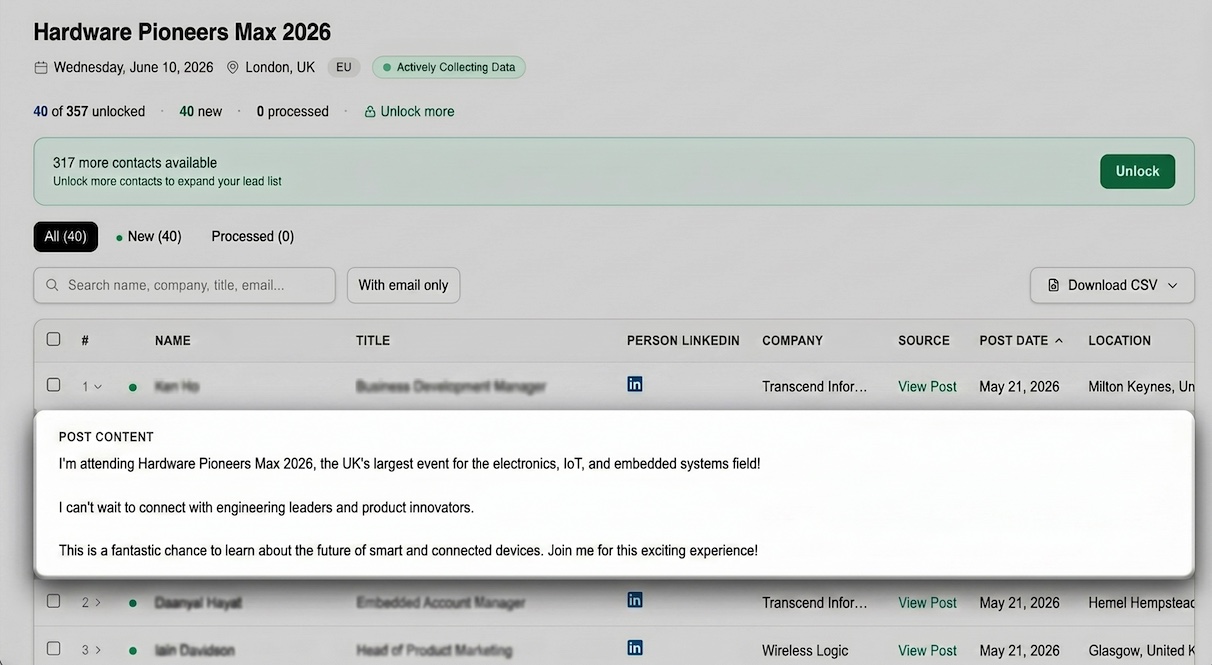
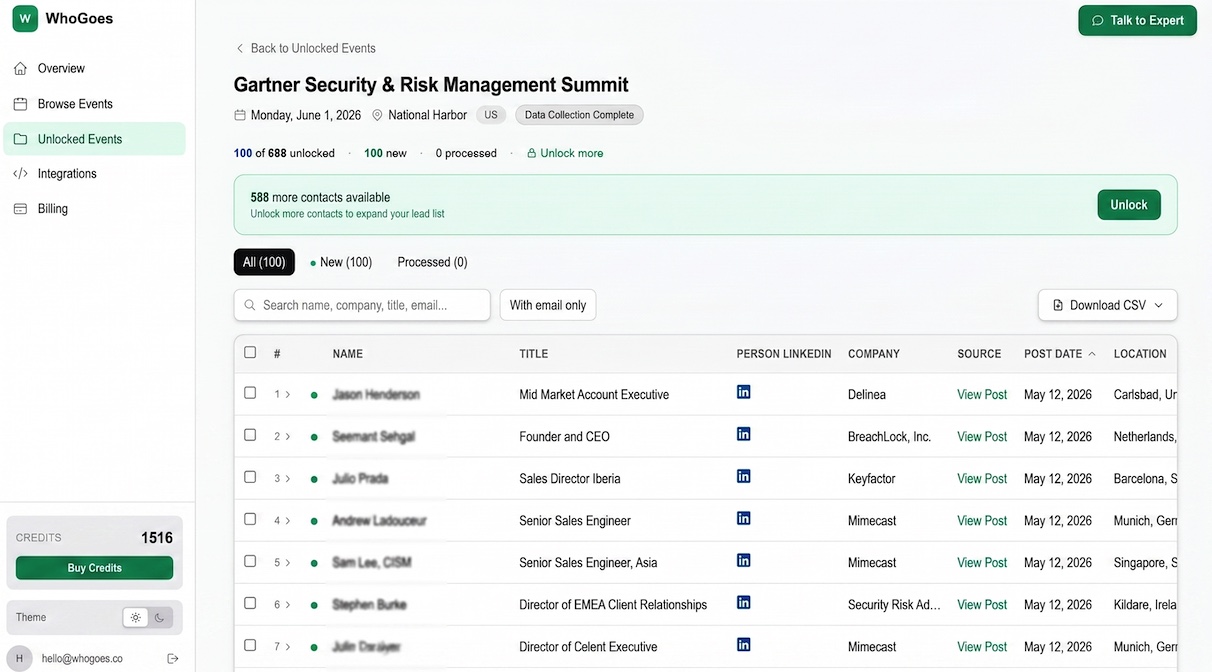
WhoGoes is a focused attendee data platform. It surfaces individual contacts who attended or plan to attend specific events, sourced from public LinkedIn posts, with verified emails and proof of attendance.
What Matters Most
- Grata tracks 25,000+ conferences at the company level; WhoGoes provides individual contact data for 1,200+ events
- Grata is priced for PE/M&A teams ($10,000+/year); WhoGoes is pay-as-you-go at $29 for 200 contacts
- WhoGoes includes LinkedIn proof of attendance for every contact; Grata shows company-level conference participation
- Grata requires an annual subscription; WhoGoes has no contract and credits never expire
- WhoGoes provides instant delivery with a free 5-contact preview; Grata requires platform onboarding
| Feature | WhoGoes | Grata |
|---|---|---|
| Primary use case | Sales outreach to event attendees | Deal sourcing, M&A, private market research |
| Conference coverage | 1,200+ events | 25,000+ conferences |
| Data level | Individual contacts (name, email, title) | Company-level (which companies attend) |
| Attendance proof | LinkedIn proof (verifiable) | No individual proof |
| Price | From $29 (pay-as-you-go) | ~$10,000-$25,000+/year |
| Free preview | 5 contacts free per event | Demo available |
| Verified emails | Yes | Company contacts available |
| Contract | No contract, credits never expire | Annual subscription |
| CRM integration | CSV export | Salesforce, DealCloud, HubSpot |
| Target buyer | SDRs, sales teams, marketers | PE firms, M&A teams, BD professionals |
What Grata Is Built For
Grata is a strong platform for its core audience:
- Massive conference database: 25,000+ conferences tracked. Grata covers more events than most platforms because it's tracking company attendance across the entire private market.
- Company-level intelligence: See which companies are attending, exhibiting, or sponsoring specific events. Useful for identifying acquisition targets or partnership opportunities at conferences.
- Private market data: Company search by ownership type, industry, employee count, revenue, growth signals, and more. Conference data is one signal within a broader intelligence stack.
- Autopilot alerts: Get notified when target companies register for conferences. Proactive, not reactive.
- CRM integration: Native connections to Salesforce, DealCloud, and HubSpot. Push conference intelligence directly into deal workflows.
- Mobile app for events: Look up attendee companies, take notes, and update deal status during events.
For PE firms running deal sourcing or BD teams tracking target companies across the conference circuit, Grata's conference feature is a valuable add-on to an already powerful platform. Strong tool. Right context. The 25,000-event database and company-level attendance tracking make Grata uniquely suited to private market professionals who need conference intelligence as part of a broader deal sourcing workflow, not as a standalone outreach tool for individual SDRs.
Why Sales Teams Choose WhoGoes
Individual contact data. Proof included. Here's where the gap matters most for SDRs and sales teams running event outreach rather than deal sourcing, because the workflow is completely different when your goal is to send personalized emails to specific people rather than to track which portfolio companies are attending which conferences.
1. Individual contact data, not just company names
Grata tells you which companies attend a conference. WhoGoes tells you which people attend, with their name, job title, company, verified email, and LinkedIn post. For SDRs who need to email specific people, company-level data isn't actionable on its own. You still need to figure out who at that company went, what their email is, and whether they actually showed up.
WhoGoes skips that entire step. Try it on any event — HIMSS 2026 is a good example of the depth of individual contact data available.
2. Massively lower cost for sales teams
Grata's pricing makes sense for PE firms running platform-wide deal sourcing. But for a sales team that needs attendee data for 5-10 events per quarter, $10,000-$25,000/year is a hard sell when WhoGoes covers the same events at $29 per 200 contacts.
Ten events through WhoGoes: $290. Ten events factored into a Grata subscription: you're paying for an entire private market platform to use one feature.
3. LinkedIn proof of attendance
Every WhoGoes contact links to their public LinkedIn post about the event. You can verify the person actually attended or plans to attend. Grata's conference data shows company registrations but doesn't provide individual-level attendance proof. When your outreach says "I saw you attended [Event]," that claim needs to be accurate.
4. No subscription, no commitment
WhoGoes is pay-as-you-go. Buy credits when you need them. Credits never expire. No annual contract, no platform onboarding, no minimum spend. For teams that cover events seasonally or want to test attendee data before committing budget, this flexibility matters.
The Right Tool for Your Team
Two buyers. Two tools. Use Grata if:
- You're in PE, M&A, or corporate development and need conference intelligence as part of broader deal sourcing
- You want to track which companies (not individuals) attend 25,000+ conferences
- You already use Grata for private market research and want to add conference tracking to your workflow
- Your budget supports $10,000+/year platform spend
Use WhoGoes if:
- You need individual contact data for pre-event or post-event sales outreach
- You want LinkedIn proof that each person actually attended
- You cover 5-20 events per quarter and need affordable, event-specific attendee lists
- You want instant access with a free preview before spending anything
Use both if:
- Your BD team uses Grata to identify which target companies are attending conferences, then your SDR team uses WhoGoes to find the specific people from those companies who posted about attending, complete with verified emails and conversation starters
Different buyers. Different motions. The Grata buyer is a PE associate or corporate development director managing a portfolio of target companies and conference relationships; the WhoGoes buyer is an SDR or sales manager who needs a list of specific people attending next month's trade show and doesn't have days to spare before outreach needs to start.
For a complete comparison of all event attendee data methods, see How to Get a Trade Show Attendee List in 2026.
Ready to get your attendee list?
Browse 1,200+ trade shows. 5 free preview contacts per event.
Browse Events Free