WhoGoes vs Apollo.io for Event Prospecting: Attendee Lists vs Contact Database
Event attendee lists vs general contact database
Quick answer: Apollo.io is a general B2B sales platform with 275M+ contacts ($49 to $119/user/mo). WhoGoes provides verified attendee lists for specific trade shows with LinkedIn proof and emails ($29). Apollo has everything except event attendance data. WhoGoes fills that exact gap.
Many sales teams already use Apollo.io. It's the go-to sales engagement platform for startups and SMBs. So when trade show season comes around, the natural instinct is to use Apollo for event outreach too. The problem: Apollo has no idea who attended any event.
Apollo.io is a B2B sales intelligence and engagement platform. 275M+ contacts, email sequences, buyer intent signals, and a generous free tier. It's one of the most popular sales tools on the market.
WhoGoes is an event attendee data platform. It gives you individual contacts who attended specific trade shows, with verified emails and LinkedIn proof. Starting at $29.
Key Takeaways
- Apollo.io has 275M+ contacts but zero event attendance signal; WhoGoes is built entirely around event attendance
- Apollo can tell you who works at a company; WhoGoes tells you who attended a specific trade show
- Apollo starts at $49/user/mo (or free with limits); WhoGoes starts at $29 pay-as-you-go with no subscription
- Best approach: use WhoGoes for the event signal, then run sequences in Apollo
| Feature | WhoGoes | Apollo.io |
|---|---|---|
| Event attendance data | Yes, 1,200+ events with LinkedIn proof | No event-specific data |
| Price | From $29 (pay-as-you-go) | Free (limited) to $119/user/mo |
| Contact database size | Event attendees only | 275M+ contacts |
| Verified emails | Included | Included (credit-based) |
| LinkedIn proof of attendance | Yes | No |
| Pre-event outreach | Built for this | Not event-aware |
| Email sequences | No | Yes, built-in |
| Buyer intent signals | Event attendance | Topic-level buying intent |
| Contract | No contract, credits never expire | Monthly or annual subscription |
What Apollo.io Does Well
Credit where it's due. Apollo.io packs a lot into one platform:
- Massive database: 275M+ contacts with emails, phone numbers, and company data
- Email sequences: Built-in outreach with A/B testing, auto-follow-ups, and scheduling
- Buyer intent: Topic-level intent signals to identify accounts showing interest
- Generous free tier: 10,000 monthly email credits on the free plan
- CRM integration: Syncs with Salesforce, HubSpot, and others
- Enrichment: Company data, job changes, and technographics
For general B2B prospecting, Apollo is one of the best value-for-money platforms available. No argument there. Solid tool. Hard to beat. For outreach outside of event season, Apollo's combination of a massive contact database, built-in sequencing, and generous free tier gives small sales teams everything they need to run consistent, scalable prospecting campaigns without breaking the budget.
The Event Data Gap in Apollo
Here's the problem: Apollo can filter contacts by company, job title, industry, location, and dozens of other criteria. It cannot filter by "attended CES 2026." That data point doesn't exist in Apollo's model. That's the blind spot. Big one. Apollo's data model was built for company and role-based targeting, not event attendance, which means any "event outreach" you run from Apollo is really just company-filtered outreach with a trade show theme bolted on after the fact.
So if you're planning trade show outreach, Apollo gives you a list of people who might be at the event based on their company and role. That's a guess. Maybe the VP of Marketing at Acme Corp is going to SaaStr Annual. Maybe she's not. Apollo doesn't know.
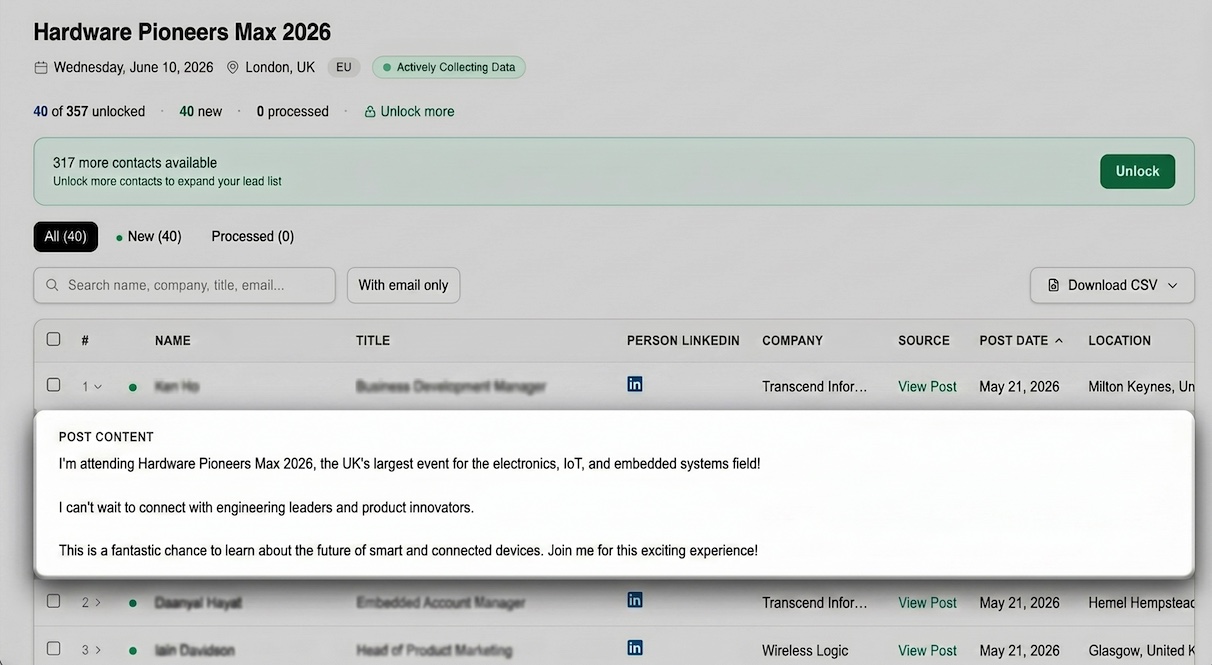
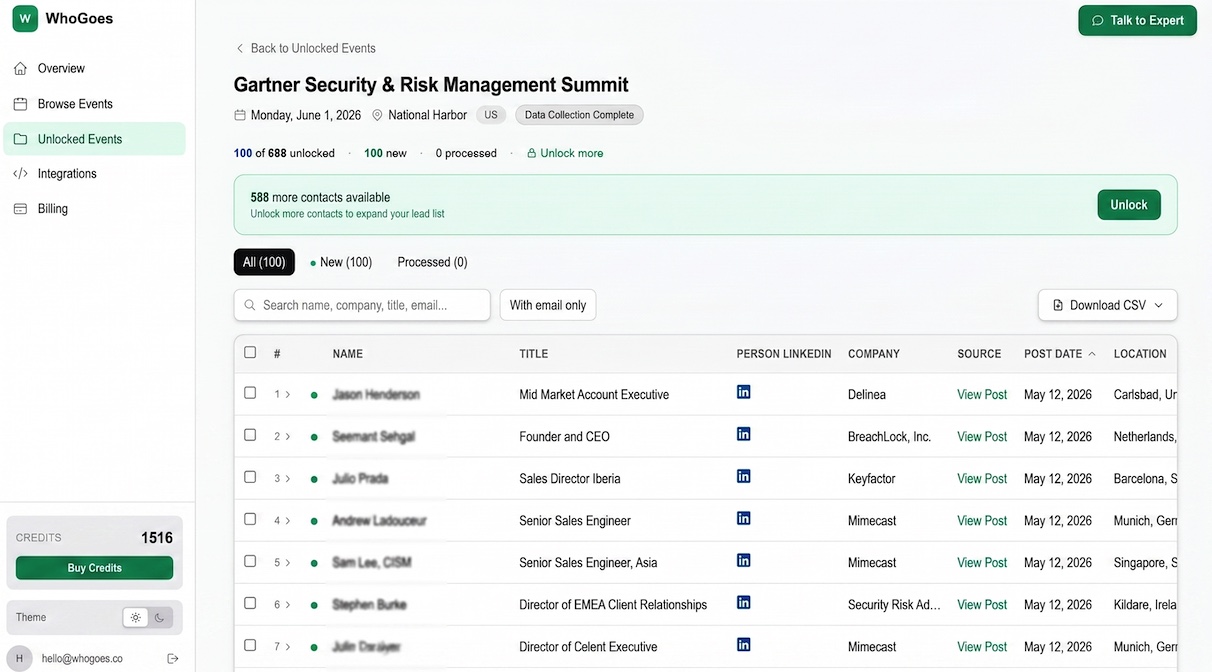
WhoGoes knows. It monitors public LinkedIn posts about trade shows and conferences. Every contact has a linked source post proving they attended or plan to attend.
The difference between "probably attending" and "definitely attending, here's the LinkedIn proof" is the difference between a cold email and a warm introduction.
Where WhoGoes Wins
Four things stand out. Clearly. WhoGoes was purpose-built for event-based outreach, so every feature, from the LinkedIn proof links to the pay-per-event pricing model, is optimized for the specific workflow of reaching people who attended or plan to attend a specific trade show.
1. Verified event attendance
WhoGoes doesn't guess who attended. It shows you, with LinkedIn proof. Every contact is linked to a public post about the event. "I saw you're heading to NRF 2026" is a much better opener than "I noticed your company is in retail."
2. Pre-event timing
WhoGoes lists build in real-time as people post about upcoming events. You can start outreach weeks before the show, while Apollo has zero awareness of who's attending what.
3. No subscription required
Apollo's free tier is generous but limited. Paid plans start at $49/user/mo. WhoGoes is $29 for 200 contacts, pay-as-you-go. No monthly commitment, credits never expire. If you only do event outreach a few times a year, WhoGoes is dramatically cheaper.
4. The context advantage
"I saw you're speaking at Web Summit" converts better than "I noticed you're a VP of Engineering at a SaaS company." Event context makes outreach personal without being creepy. WhoGoes gives you that context automatically.
Using WhoGoes + Apollo Together
Best of both. Simple workflow. Here's what the smartest teams do: combine WhoGoes for the event signal, which gives you proof of attendance and verified contacts, with Apollo for the outreach sequences, which handles the email automation, follow-ups, and A/B testing that WhoGoes doesn't offer.
- WhoGoes identifies who attended the event: names, emails, companies, LinkedIn proof
- Apollo runs the outreach sequence: email series referencing the event, auto-follow-ups, A/B testing
This combo gives you Apollo's sequencing power with WhoGoes' event signal. The event context makes the outreach relevant, and Apollo's automation makes it scalable.
You can export WhoGoes contacts as CSV and import directly into Apollo sequences. The whole workflow takes minutes.
Who Should Use Apollo.io Alone?
Good fit too. Honest answer. Apollo is sufficient if:
- You don't do event-based prospecting and need a general contact database with sequences
- Your outreach is based on company, role, or industry targeting rather than event attendance
- You need built-in email sequences and engagement tracking
- You want a free tier to get started with general prospecting
Good fit. Honest answer. Apollo alone works well for teams whose outreach strategy doesn't rely on event attendance as a signal, and for those teams the combination of 275M contacts, a generous free tier, and built-in sequencing is hard to match at any price point.
Who Should Use WhoGoes?
Event focus. Pure signal. WhoGoes is the right tool if:
- You need to know who attended specific trade shows
- You want LinkedIn proof to reference in outreach
- You're doing pre-event or post-event outreach and timing matters
- You need affordable access without a monthly subscription
Event-first. Always. WhoGoes is purpose-built for sales teams that treat trade shows as a primary prospecting channel, where knowing who attended a specific event, with verifiable proof, is more valuable than having access to a generic database of 275 million contacts you can't filter by event attendance.
Ready to get your attendee list?
Browse 1,200+ trade shows. 5 free preview contacts per event.
Browse Events FreeBottom Line
Apollo.io is a comprehensive B2B sales platform with 275M+ contacts, email sequences, and buyer intent. But it has a blind spot: event attendance data. WhoGoes fills that exact gap with verified attendee lists and LinkedIn proof, starting at $29. For event-based prospecting, use WhoGoes for the signal and Apollo for the sequence. That's the power combo. Simple stack. Proven play. If you're running event outreach more than once a quarter, combining WhoGoes' verified attendance data with Apollo's sequencing infrastructure gives you a workflow that neither tool can deliver on its own.
Related: What Is a Trade Show Attendee List?, a primer on attendee lists and why LinkedIn proof matters for trade show outreach.
More comparisons: WhoGoes vs manual LinkedIn search and WhoGoes vs buying organizer lists.